Something Lurking - VR Exploring Experience
Something Lurking is an immersive VR experience set inside an abandoned space station.
00
problem
Traditional VR exploration experiences often rely on static scale and external UI overlays, which can reduce immersion and narrative tension. Our objective was to design a fully immersive VR narrative where: Scale transformation becomes a core mechanic, not just visual spectacle UI remains diegetic and integrated into the world Environmental storytelling replaces heavy exposition Tension emerges through space, sound, and interaction, rather than enemies alone This design aimed to create a slow-burn psychological experience within an empty spacecraft environment.
solution
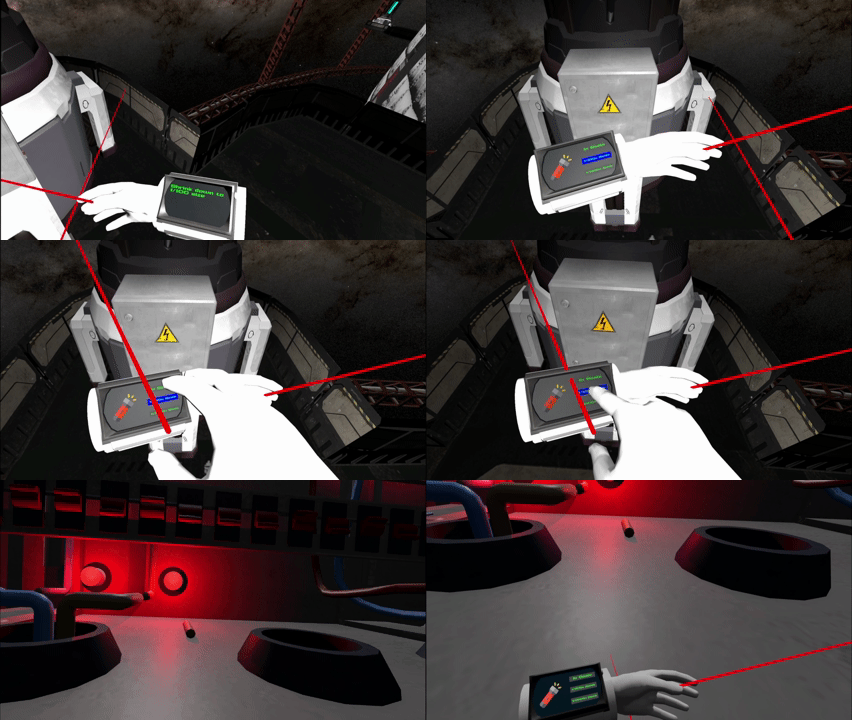
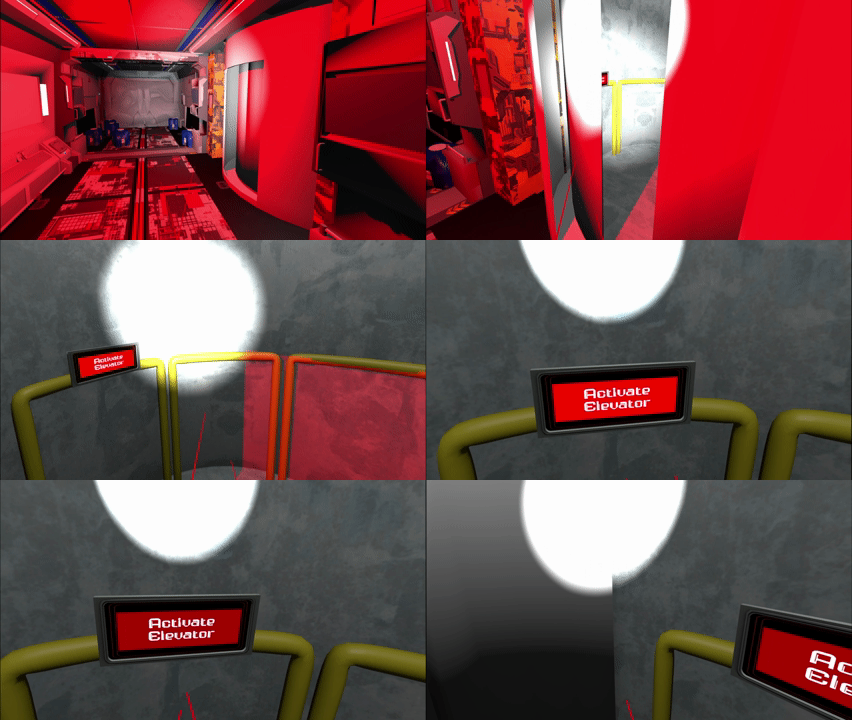
Narrative Structure The experience follows a three-act arc: Act I – Routine: calm tutorial and fuse-repair task Act II – Descent: loss of power, isolation, and navigation through darkness Act III – Breach: restoration attempt followed by ambiguous escape and cliffhanger ending This progression gradually transforms safety into uncertainty, ending with unresolved tension. Core Interaction Systems 1. Diegetic Wrist-Mounted UI: Scale switching (1:1, 1:100, 1:1000) Flashlight toggle Objective guidance Embedding UI on the player’s arm preserved immersion inspired by diegetic interface design in sci-fi games. 2. Grab-Based Physical Interaction: Sliding doors with constrained motion Object pickup and grid-based placement Two-hand scaling of wire components for circuit repair These mechanics reinforced tactile presence within the VR space. 3. Environmental Trigger Systems: Invisible detection zones dynamically: Open doors Trigger sound/dialogue Change lighting Enable progression This allowed the environment itself to function as a narrative system
From its inception, Something Lurking set out to explore how immersive VR environments could transform narrative tension and spatial storytelling. Born from our team’s shared interest in isolation, scale, and environmental interaction, the project evolved into a multi-scale exploration experience inside an abandoned space station. By integrating diegetic interfaces, tactile VR interactions, and atmospheric sound design, we aimed to create a journey driven by discovery rather than combat.
The project’s final demo was selected by Simon Fraser University as a featured showcase to introduce prospective students.
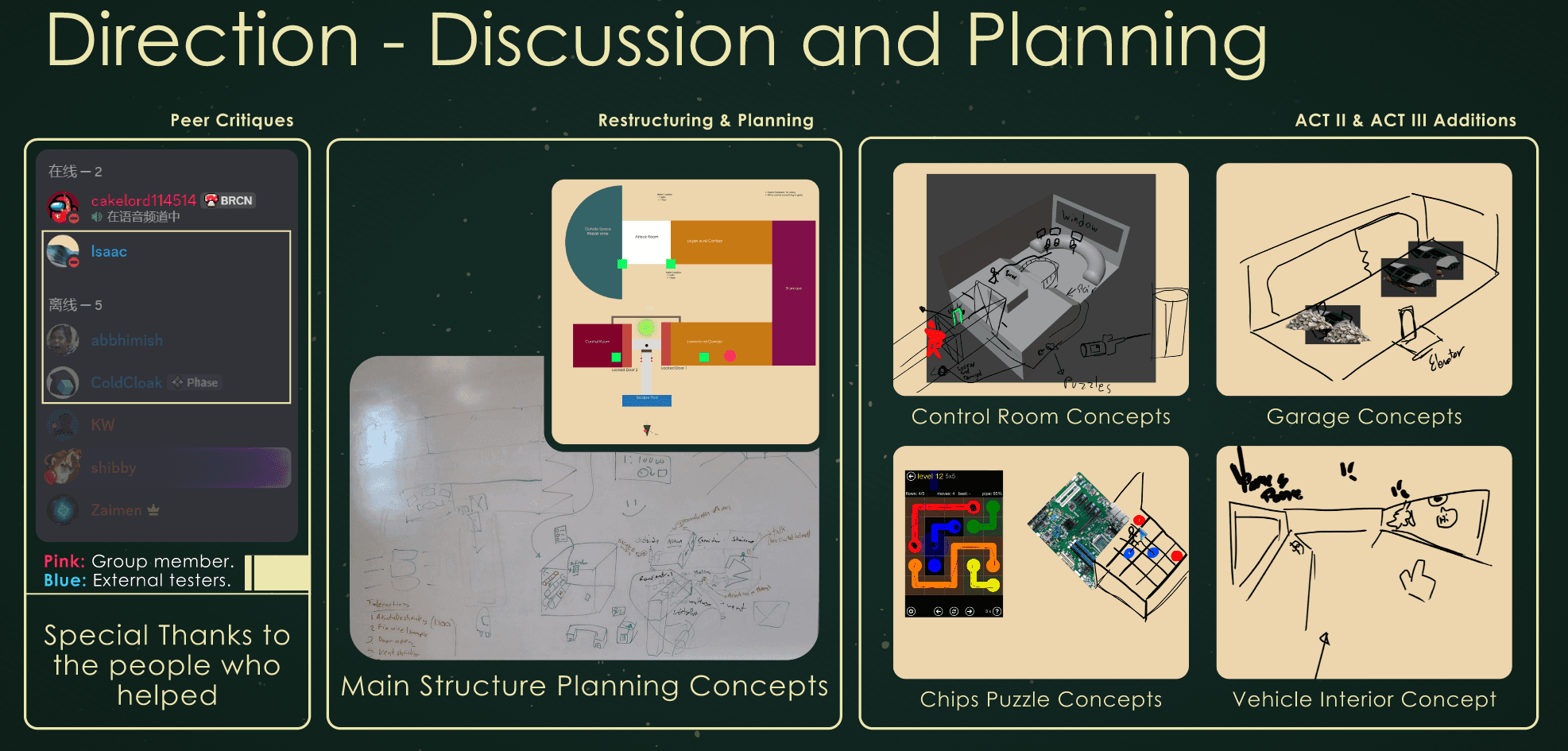
Early in development, our team recognized that achieving a cohesive VR narrative required more than technical implementation, it demanded a clear design direction grounded in critique, spatial planning, and iterative discussion.
Through structured peer feedback and external playtesting, we identified the need for stronger environmental progression, clearer puzzle logic, and a more deliberate emotional arc across the experience.
In response, I led the restructuring of the project’s spatial and narrative framework, translating discussion outcomes into concrete planning artifacts, including whiteboard flow diagrams, level-to-level progression mapping, and early concept sketches for the new features and maps, which are control room, garage, chip-space puzzle, and escape vehicle interior. These materials established the three-act experiential structure and clarified how scale transitions, interaction pacing, and environmental storytelling would guide the player’s movement and tension over time.
This planning phase became the conceptual foundation for the final VR environment, ensuring that later production decisions remained aligned with a unified artistic and experiential vision.
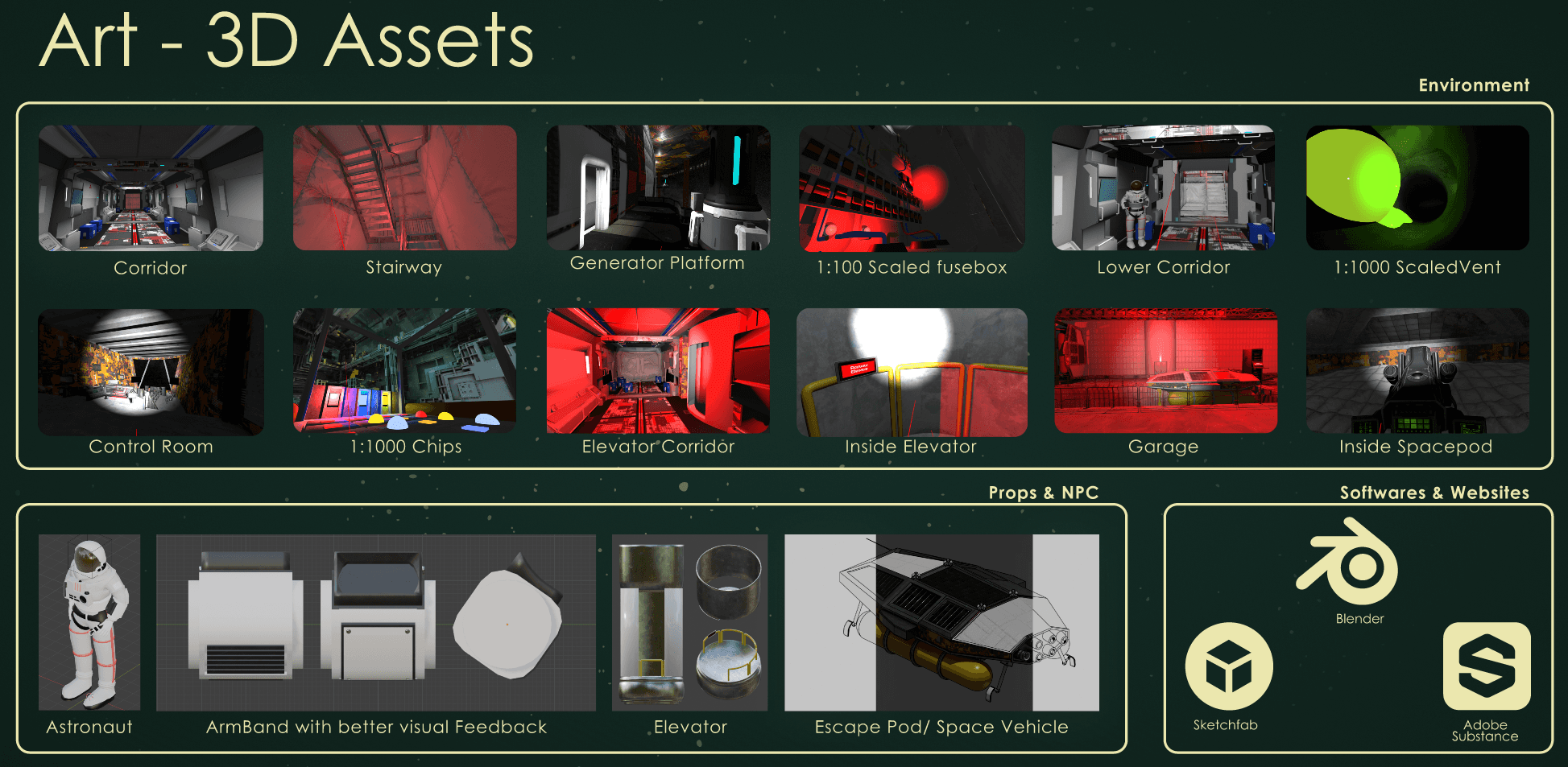
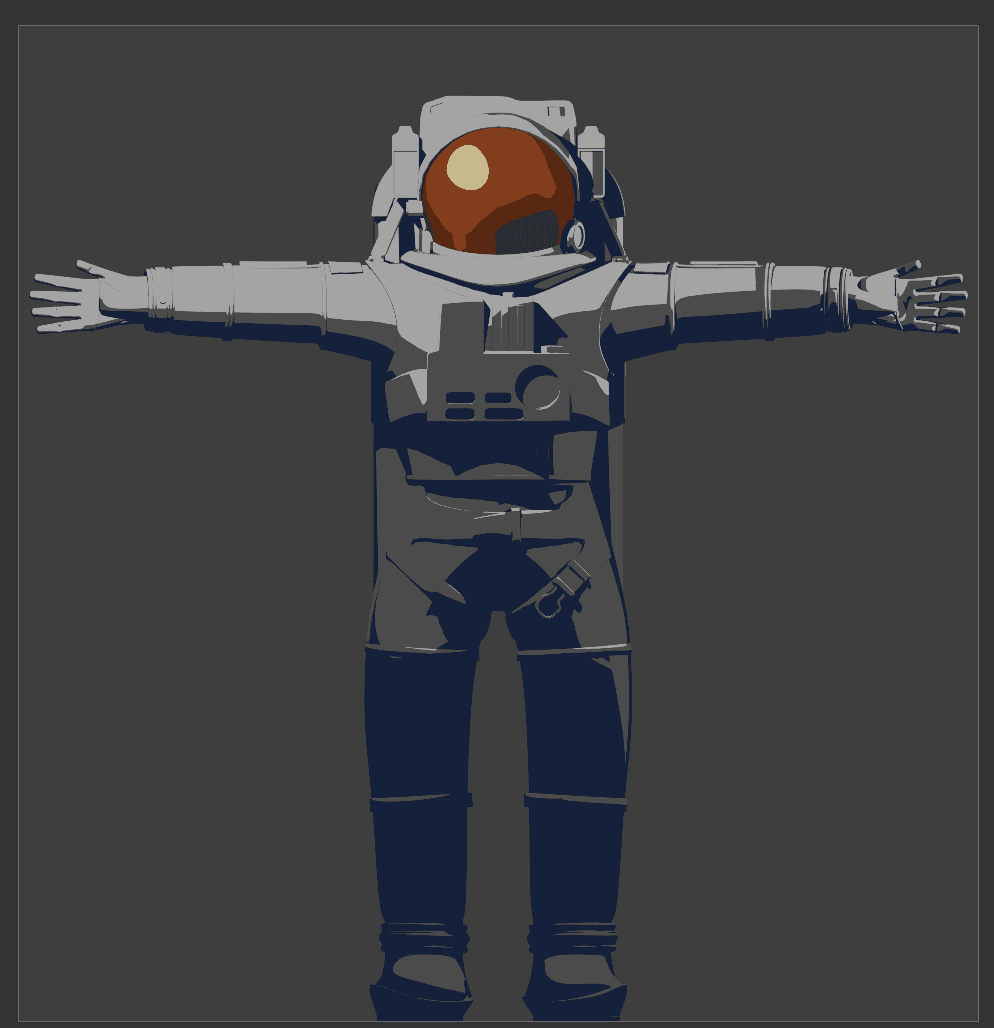
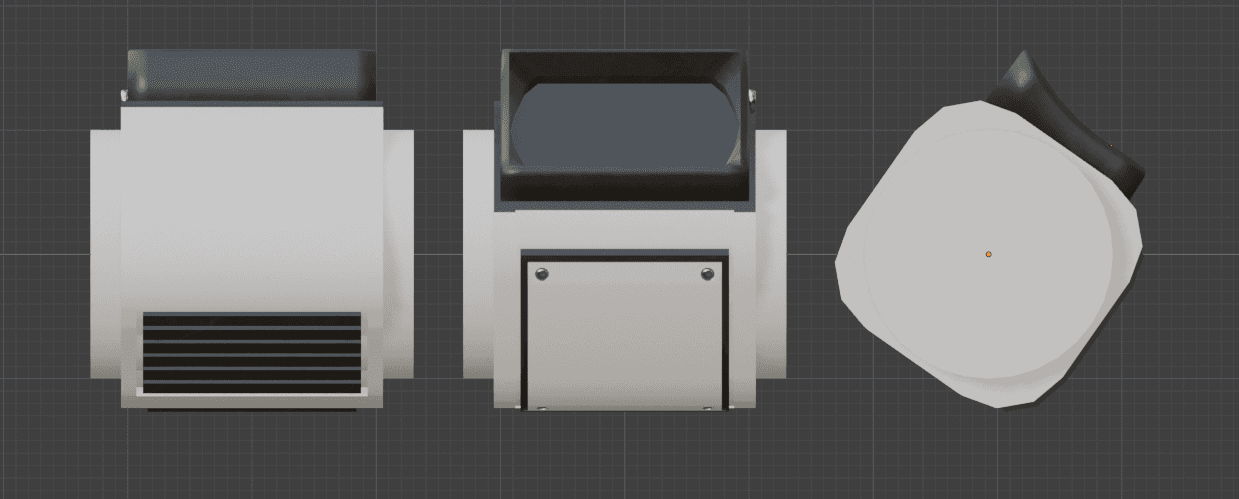
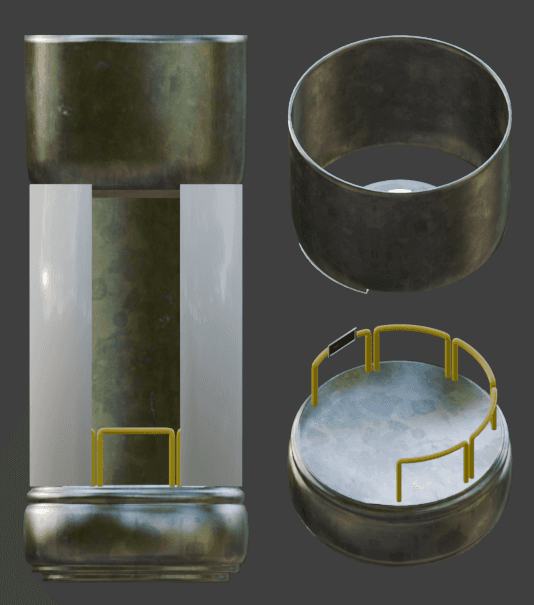
As the project’s primary Art Director and Level Designer, I led the development of the game’s visual language, spatial progression, and core gameplay loop within a collaborative VR production environment. Working from an initial concept of isolation inside a multi-scale space station, I shaped the overall art direction and designed the environmental flow across three distinct scales to support narrative tension and player navigation. I modeled most of the complete set of in-game environments in Blender, designed material in substance designer and ensured visual consistency, performance stability, and clear storytelling cues throughout the experience.
This foundation enabled the team to build cohesive interaction systems and stronger narrative pacing, ultimately contributing to a polished final demo that was selected by Simon Fraser University as a featured showcase for introducing future students to the course’s creative and technical outcomes.
01
02
03
04
05
06
see also